

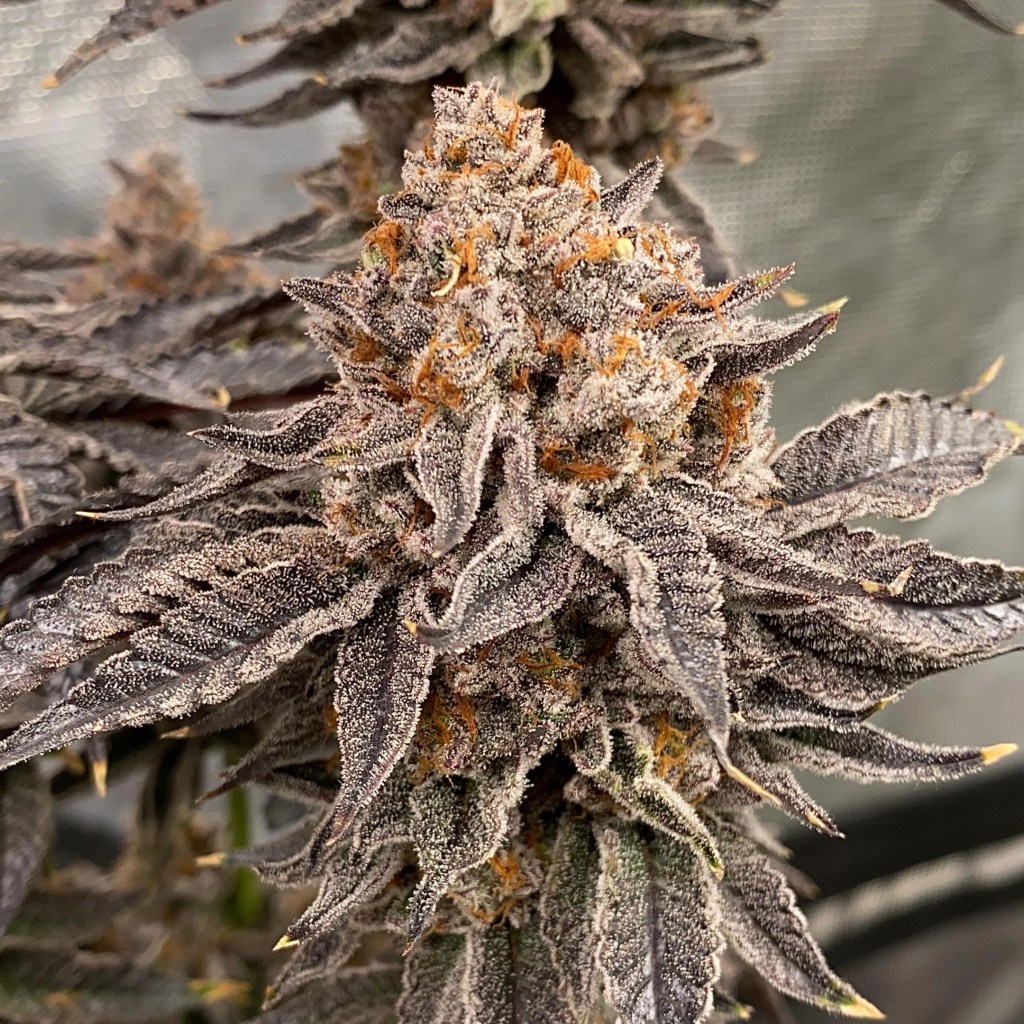
- Strain Type: Indica-leaning hybrid
- Genetics: Girl Scout Cookies phenotype
- Breeder: Cookie Fam
- THC Content: 20–28%
- CBD Content: Low to trace
- Terpene Profile: Limonene, beta-caryophyllene, linalool
- Primary Flavors: Cookie dough, roasted nuts, vanilla
- Flowering Time (Indoor): 8–10 weeks
- Outdoor Harvest Time: early to mid-October
- Indoor Yield: Low to moderate
- Outdoor Yield: Moderate
- Grow Difficulty: Advanced
Few marijuana strains have influenced modern breeding as heavily as OGKB while remaining comparatively difficult to grow on its own. Short for OG Kush Breath, OGKB is the legendary clone-only Cookies selection behind such influential families as Do-Si-Dos and numerous later Breath, Dough, and Cookies hybrids. Its fame does not come from rapid growth or enormous harvests. In fact, the authentic plant is notorious for almost painfully slow vegetative development, unusual leaf morphology, compact branching, and demanding cultivation behavior.
What growers receive in exchange is exceptional flower: dark, dense buds covered in resin and carrying a deep aroma of cookie dough, roasted nuts, vanilla, earth, pepper, and old-fashioned Kush fuel. Archive Seed Bank, which used the verified NorCalICMag OGKB clone to create Do-Si-Dos, confirms both the clone-only status and the uncertainty surrounding its precise beginnings. Modern laboratory testing shows the cultivar can still compete with newer high-potency weed, with a July 2026 OGKB batch reaching 26.2% total THC and 2.45% total terpenes.
Genetics and Lineage
OGKB is best understood as a clone rather than a conventional strain created from a clearly documented seed cross. It has long been associated with the original Girl Scout Cookies family and is commonly described as a distinctive GSC phenotype. Cookies itself describes its foundational G.S.C. genetics as reportedly originating from OG Kush crossed with a unique Durban Poison cut. The OGKB selection expresses a particularly heavy, Kush-oriented side of that genetic family, producing broader leaves, dense flower development, darker coloration, and a more physically relaxing high than some other famous Cookies selections.
There is an important historical complication. Archive Seed Bank, one of the breeders with extensive firsthand experience using the original clone, states that OGKB’s precise background remains mysterious. According to Archive, competing accounts describe it either as part of the original Cookies family or as a seed discovered in Cookies flower. What is firmly documented is the clone itself. Archive obtained the verified NorCalICMag OGKB and crossed it with Face Off OG BX1 to create Do-Si-Dos, later backcrossing Do-Si-Dos to OGKB to produce OGKB BX1.
That uncertainty is worth preserving rather than replacing with a cleaner but potentially inaccurate family tree. OGKB should also not be confused with OGKB 2.0 or OGKB 2.1. These are later derivatives rather than alternative names for the original clone. For example, 710 Labs identifies OGKB 2.1 as OG Kush Breath × Do-Si-Dos, bred by In House Genetics. The original OGKB remains the clone-only plant at the root of those later breeding projects.
Effects and Experience
OGKB has a reputation for delivering more physical weight than many Cookies-family cultivars. The opening can still be distinctly euphoric. Mood rises, thoughts become looser, and ordinary entertainment may suddenly become considerably more absorbing. There can be a warm social quality during this stage, but the mental stimulation is rarely sharp or restless. Instead, the cerebral effect tends to feel rounded, almost as though the high is preparing the consumer for the heavier physical phase that follows.
Over the next several minutes, the body component becomes increasingly difficult to ignore. Muscular tension can recede, limbs feel heavier, and a comfortable seated position becomes much more appealing. Higher doses may produce pronounced couch-lock and sleepiness, making this cannabis better suited to late afternoon or evening for many people. Appetite stimulation can also become noticeable once the initial cerebral phase settles.
Potency should not be underestimated simply because OGKB predates the current era of 30%-plus THC labels. A July 2026 laboratory sample contained 29.74% THCA and 26.2% calculated total THC, while a January 2026 batch measured 26.74% total THC. For inexperienced consumers, excessive amounts can cause dry mouth, red eyes, dizziness, anxiety, impaired concentration, or uncomfortable sedation.
Medical Benefits
The strong transition from mental decompression into physical relaxation helps explain OGKB’s long-standing interest among medical marijuana consumers. Some patients prefer heavy Cookies and Kush-derived cultivars when temporary physical discomfort, muscular tension, appetite loss, stress, or difficulty settling down becomes more problematic later in the day. Unlike intensely stimulating cannabis, OGKB generally moves toward a quieter and more physically grounded state as the session progresses.
Its chemistry provides additional context. The July 2026 batch referenced above contained 2.45% total terpenes, led by limonene at 0.69%, beta-caryophyllene at 0.565%, linalool at 0.378%, humulene at 0.19%, and myrcene at 0.189%. Another 2026 OGKB flower analysis showed beta-caryophyllene as the leading terpene, illustrating how phenotype, environment, harvest timing, and curing can alter the dominant order while preserving a broadly similar spicy, earthy, floral, and citrus profile.
OGKB itself has not been clinically proven to treat chronic pain, insomnia, anxiety, depression, or another medical condition. Patients should therefore use the cannabinoid and terpene analysis for the specific product they purchase rather than assuming every example of the strain will produce identical effects.
Flavor Profile and Aroma
OGKB helped establish the doughy aromatic language now found throughout modern Cookies and Breath genetics. Freshly opened flower can give off an unusually dense combination of sweet dough, roasted nuts, damp earth, vanilla, pepper, and Kush-like fuel. There is sweetness, but it is darker and less sugary than the candy-heavy profiles that later became common. The smell can sometimes take on a funky, almost savory edge that separates authentic OG Kush Breath from ordinary dessert weed.
The inhale frequently introduces nutty cookie dough and mild vanilla before spice and earth begin to expand through the palate. Fuel becomes more obvious on the exhale, accompanied by pepper, herbs, and occasional berry or floral accents. Archive Seed Bank specifically notes a characteristic doughy OGKB backend in OGKB-dominant Do-Si-Dos selections, showing how reliably that aromatic trait can pass into offspring.
Modern testing reinforces the complexity of the aroma. Limonene provides citrus brightness, caryophyllene contributes peppery spice, linalool brings softer floral character, and humulene and myrcene strengthen the earthy, herbal foundation. A proper cure allows those components to remain distinct instead of collapsing into a generic Kush flavor.
Growing Information
OGKB is famous for being difficult to cultivate, and the authentic clone behaves very differently from the vigorous commercial hybrids it later helped produce. Vegetative growth is exceptionally slow. The plant develops unusual broad, sometimes distorted-looking leaves and short internodal spacing, earning descriptions such as “mutant Cookies” among growers who maintained the original cut. Verified clone material continues to note this extremely slow growth behavior. Growers planning a conventional production schedule should therefore allow substantially more vegetative time than they would for a modern fast-growing hybrid.
Indoor flowering generally requires about eight to ten weeks once the plant is finally large enough to flip. Training should be gentle and deliberate because every setback during vegetation costs valuable time. Topping can help establish additional leaders, but repeated aggressive pruning is rarely worthwhile on such a slow plant. An extended vegetative period followed by careful canopy organization is usually preferable. Yield is typically low to moderate compared with modern commercial marijuana genetics, which is one reason OGKB became more influential as a breeding parent than as a production strain.
The reward arrives during flower development. Dense buds build considerable trichome coverage, and dark green or purple coloration can appear as maturity approaches. Air movement and humidity control are particularly important around compact flowers. Outdoor cultivation is possible where the growing season is sufficiently long, but the slow early development makes OGKB less forgiving than vigorous outdoor varieties. Harvest generally falls around early to mid-October in suitable Northern Hemisphere conditions, although trichome maturity should determine the final date.
FAQ
What does OGKB stand for?
OGKB stands for OG Kush Breath. The name refers to the famous clone-only cannabis selection that became an important parent in numerous Cookies, Breath, Dough, and Kush-related breeding projects.
What are the genetics of OGKB?
OGKB is generally recognized as a clone-only selection associated with the original Girl Scout Cookies family. Cookies describes G.S.C. as reportedly deriving from OG Kush × a unique Durban Poison cut, but Archive Seed Bank notes that the exact origin of the OGKB clone remains disputed.
Is OGKB the parent of Do-Si-Dos?
Yes. Archive Seed Bank created Do-Si-Dos by crossing the verified NorCalICMag OGKB clone with Face Off OG BX1. This cross helped spread OGKB’s doughy aroma, dark coloration, resin production, and heavy effects into an enormous number of later cannabis hybrids.
Is OGKB a strong strain?
Yes. OGKB is considered high-potency marijuana. A July 2026 batch tested at 26.2% total THC with 29.74% THCA before decarboxylation, while another January 2026 batch reached 26.74% total THC.
Is OGKB difficult to grow?
Yes. The original clone is notoriously slow during vegetative growth and displays unusual plant morphology. Its modest production and long veg time make it less commercially efficient than many of its descendants, although the finished flower and breeding value can be exceptional.
Final Thoughts on OGKB
OGKB earned legendary status without being an easy marijuana strain to cultivate. Slow vegetative growth, unusual leaves, modest yields, and demanding plant behavior would normally have caused a cultivar to disappear. Instead, the quality of its resin, dense flower structure, heavy effects, and doughy Kush aroma made breeders willing to preserve it. Archive Seed Bank’s use of the clone in Do-Si-Dos alone guaranteed an enormous genetic legacy, with OGKB traits subsequently spreading throughout modern Cookies, Breath, Cake, Dough, and Kush breeding.
For consumers, the attraction remains much simpler. OGKB delivers potent, body-oriented cannabis with a flavor that moves through cookie dough, vanilla, roasted nuts, pepper, earth, and fuel rather than relying on extreme fruit sweetness. For growers, it is a challenging historical cultivar whose offspring are often easier to handle than the original. For breeders, however, OG Kush Breath occupies a far more important position: it is one of the clone-only selections that helped define the flavor, structure, resin production, and potency of an entire generation of modern weed.


