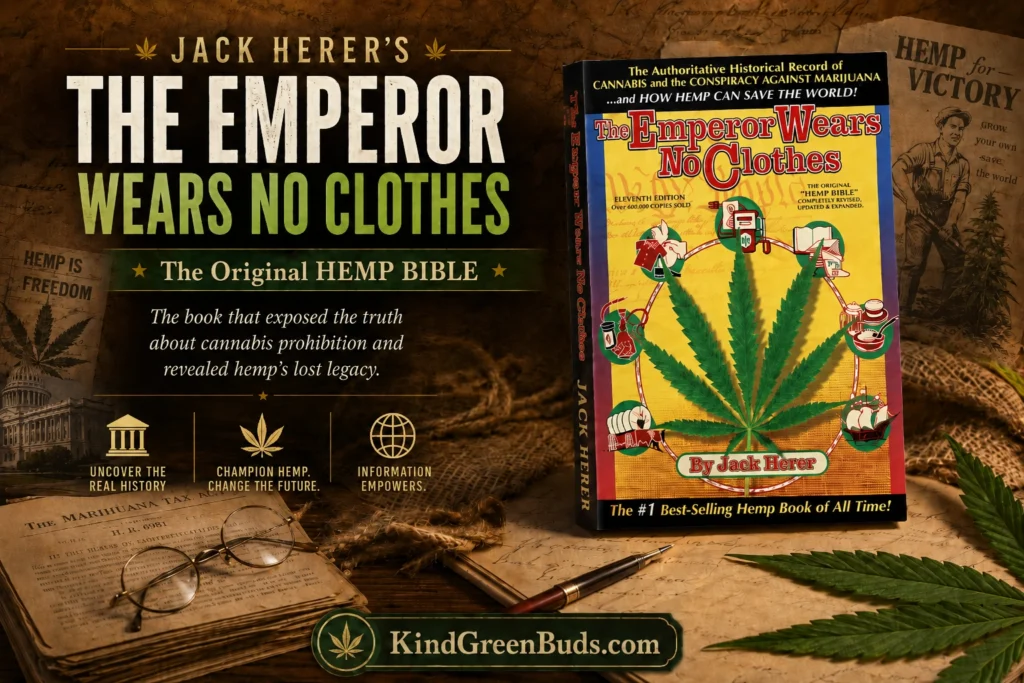
Jack Herer’s The Emperor Wears No Clothes is one of the most influential books ever written about cannabis prohibition and the industrial potential of hemp. First published in 1985 after years of research and activism, the book combines history, political argument, environmental advocacy, archival material, and polemic into a sweeping case for ending cannabis prohibition. Herer does not approach the subject as a detached historian. His purpose is to persuade the reader that cannabis was once an ordinary and valuable agricultural resource, that its prohibition resulted from misinformation and powerful political and economic interests, and that restoring hemp to agriculture could provide alternatives to many resource-intensive industries. Later editions expanded the original argument with additional historical documents and contemporary material.
The book’s title borrows its central metaphor from Hans Christian Andersen’s The Emperor’s New Clothes. Herer portrays cannabis prohibition as a system sustained because institutions, politicians, corporations, and eventually the public accepted assumptions that did not withstand scrutiny. His argument is deliberately provocative: once people understand cannabis history, he believes the apparent logic of prohibition collapses. Some of Herer’s historical observations anticipated conclusions later supported by scholarship, while several of his economic and environmental claims are much broader than current evidence can justify. Reading the book today is therefore most valuable when it is understood simultaneously as cannabis history, activist literature, and a document of the modern legalization movement.
The Book’s Central Argument
Herer’s central thesis is that modern society has been taught to think of marijuana primarily as an intoxicating drug even though Cannabis sativa has historically served many other purposes. He repeatedly asks readers to separate psychoactive marijuana from the larger story of cannabis as an agricultural crop. Hemp varieties can produce fiber, seeds, oil, cellulose-rich stalks, and construction or industrial materials while containing only small amounts of intoxicating THC. Modern scientific and government sources likewise distinguish industrial hemp from higher-THC cannabis and recognize applications ranging from fiber and seed oil to other manufactured products.
From this foundation, Herer constructs a much larger argument: prohibition did not merely criminalize recreational cannabis but also disrupted an agricultural and industrial resource with a long history. He presents hemp as a competitor to timber, petroleum, synthetic fibers, pharmaceuticals, and other industries, and he argues that the disappearance of hemp prevented society from pursuing renewable alternatives. This is the organizing idea behind nearly every part of the book. What begins as a history of marijuana law becomes a broader critique of economic power, environmental policy, government information, and the ability of institutions to define what society considers legitimate.
Hemp in Human Civilization
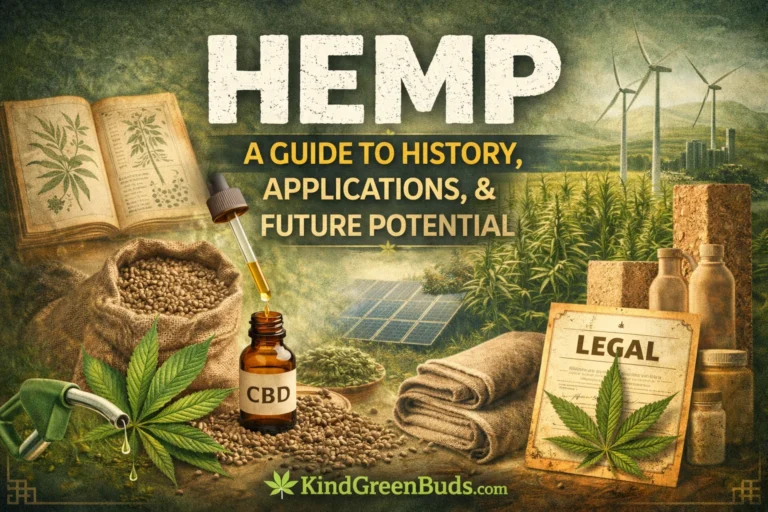
A large portion of The Emperor Wears No Clothes attempts to restore hemp to historical memory. Herer traces cannabis fiber through ancient civilizations, sailing cultures, agriculture, clothing, rope, canvas, paper, and early American farming. His larger point is not that every civilization depended entirely on cannabis, but that hemp was once a familiar commodity rather than a marginal or illicit plant. Modern agronomic literature supports the basic premise that hemp is a genuinely versatile crop whose stems, fibers, seeds, and other components can be used for textiles, food, construction materials, composites, and bioenergy.
Herer pays particular attention to American history because he wants prohibition to appear not as the continuation of a longstanding cultural taboo but as a dramatic reversal. Hemp cultivation existed in colonial and early American agriculture, and the crop regained strategic value during World War II when wartime shortages increased demand for domestic fiber. This history is important to Herer because it reveals a contradiction at the heart of prohibition: the same plant portrayed as socially dangerous could also be treated as strategically useful when national circumstances demanded it. That contradiction becomes one of the book’s recurring rhetorical tools.
How Cannabis Prohibition Took Hold
Herer’s account becomes most forceful when he reaches the early twentieth century. He argues that marijuana prohibition emerged from sensational journalism, racial prejudice, exaggerated claims about violence and insanity, and bureaucratic campaigning rather than a sober evaluation of scientific evidence. Modern scholarship supports important parts of this account. Historians have documented the racialized rhetoric surrounding marijuana and the association of the Spanish word marihuana with Mexican immigrants, while research on Harry Anslinger and the Federal Bureau of Narcotics shows how dramatic crime stories were used to influence public attitudes.
The federal turning point was the Marihuana Tax Act of 1937. Herer presents the legislation as a crucial moment when propaganda hardened into national policy. Historical research confirms that the act imposed federal controls that effectively curtailed much legitimate cannabis commerce, including medical use, even though many states had already enacted restrictions before federal action. Contemporary historical scholarship therefore supports Herer’s broad argument that prohibition did not arise from overwhelming scientific consensus, but the actual policy history is more complicated than a single coordinated campaign. State drug laws, international drug-control developments, medical debates, immigration politics, law-enforcement priorities, and changing public attitudes all contributed.
The Corporate Conspiracy Argument
The most famous—and most controversial—part of the book is Herer’s claim that powerful industrial interests helped eliminate hemp because the plant threatened emerging businesses based on timber, petrochemicals, synthetic fibers, and related technologies. He connects newspaper interests, industrial fortunes, new chemical processes, and federal drug policy into a story in which prohibition benefited corporations that might otherwise have faced competition from hemp. The argument gives the book much of its dramatic force because cannabis prohibition becomes not merely a misguided law but part of a struggle over control of natural resources.
Some elements of the economic logic are plausible: hemp genuinely can compete with other raw materials in selected applications, and modern studies continue to explore it as a source of fiber, biomass, construction material, composites, and bioenergy. But Herer often moves from evidence of potential competition to conclusions about deliberate coordinated suppression more confidently than the historical record allows. Modern research shows that hemp can perform well environmentally or agriculturally in certain systems, while also finding that its yields and economics are not automatically superior to competing crops. For example, research comparing energy crops found hemp biomass yields broadly comparable to crops such as maize and sugar beet rather than overwhelmingly greater.
Cannabis as Medicine
Herer also argues that prohibition erased an important medical tradition. Cannabis preparations had appeared in Western medicine before twentieth-century restrictions, and Herer portrays their disappearance as another example of policy overwhelming scientific inquiry. Subsequent historical scholarship confirms that cannabis had recognized medical uses before federal prohibition and that the American Medical Association objected to aspects of the 1937 legislation. Cannabis subsequently disappeared from the U.S. Pharmacopeia in the 1940s, while restrictive policies complicated research for decades.
Modern medicine has vindicated part—but not all—of Herer’s broader intuition. Cannabinoid science eventually produced approved medicines containing or derived from cannabinoids, and cannabis is now being investigated for numerous therapeutic applications. At the same time, evidence varies greatly by condition, product, cannabinoid, and dose. The National Center for Complementary and Integrative Health notes that the cannabis plant itself has not received FDA approval as a medicine, although several cannabinoid drugs have. Herer’s book is therefore historically significant for demanding renewed investigation, but many of its enthusiastic medical implications should be read as advocacy rather than settled clinical evidence.
Hemp, Energy, Paper, and the Environment
The most ambitious chapters present hemp as an environmental resource capable of reducing reliance on forests, petroleum, fossil fuels, and synthetic materials. Herer argues for hemp paper, building materials, textiles, biodegradable products, biomass energy, and other applications. This part of the book helped transform hemp from an obscure historical crop into an environmental symbol for later activists. The basic proposition that industrial hemp has substantial material versatility has aged well: modern research investigates hemp for insulation, composites, bioenergy, food, textiles, and low-carbon construction. Life-cycle research has found promising environmental performance for some hemp-based building materials.
Where the book becomes less reliable is in treating technical potential as proof that hemp is universally superior. Agricultural sustainability depends on climate, processing infrastructure, transportation, fertilizer, yield, manufacturing methods, competing materials, and what part of the plant is actually being used. Hemp can be a useful renewable crop without being the single solution to deforestation, energy dependence, climate change, or industrial pollution. Herer’s environmental vision is best understood as an argument for restoring hemp to the menu of possible resources rather than as proof that replacing conventional materials with hemp would automatically solve ecological problems.
The Strengths and Weaknesses of Herer’s Approach
Herer’s greatest strength is his ability to connect subjects that had largely been separated in popular discussion. Drug policy, agriculture, medicine, racial politics, industrial history, civil liberties, and environmentalism become parts of the same cannabis story. He fills the book with reproduced government documents, newspaper material, historical references, advertisements, and archival discoveries in an effort to let readers see evidence that was rarely included in mainstream discussions of marijuana during the 1980s. That documentary style helped make The Emperor Wears No Clothes unusually persuasive to generations of activists who encountered it before cannabis history was widely taught or researched.
Its weakness comes from the same passionate certainty that gives it energy. Herer frequently treats suggestive connections as demonstrated conspiracies, selects evidence in support of legalization, and presents optimistic technological projections as if they were inevitable outcomes. Later historians and agricultural researchers provide a more complicated picture. Racial prejudice and propaganda were genuinely significant in the development of marijuana policy, and hemp really does possess valuable industrial properties, but neither point proves every part of Herer’s larger theory. The strongest modern reading is therefore neither to dismiss the book nor to treat every assertion as established fact.
The Legacy of The Emperor Wears No Clothes
The book’s influence extends far beyond the accuracy of individual claims. Herer helped popularize the idea that cannabis reform involved more than allowing people to use marijuana. He connected legalization to industrial hemp, environmental sustainability, medical freedom, personal liberty, racialized enforcement, and distrust of government drug policy. The official Jack Herer organization describes the book as a major catalyst for the modern hemp and legalization movement, and its continuing publication decades after its 1985 debut reflects the unusual staying power of its argument.
Its deeper legacy may be the questions it forced readers to ask. Why had hemp largely disappeared from American agriculture? Why had cannabis medicine been abandoned for decades? How much of drug policy had been shaped by evidence, and how much by politics and prejudice? Could hemp compete with conventional materials? Those questions eventually moved from counterculture literature into legislatures, universities, medical research, agriculture programs, and mainstream political debate. Herer did not provide the final answers, but he helped make the questions culturally unavoidable.
Final Thoughts on The Emperor Wears No Clothes
The Emperor Wears No Clothes is best read as a foundational work of cannabis activism rather than a conventional academic history. Jack Herer assembles an enormous case around one central conviction: society misunderstood cannabis because it forgot the history of hemp and accepted prohibitionist narratives without examining where they came from. His book attempts to restore that missing history while portraying cannabis as medicine, agricultural commodity, industrial resource, environmental tool, and symbol of individual freedom.
Some of Herer’s arguments have aged remarkably well. Research confirms hemp’s legitimate industrial usefulness, historians have documented racial prejudice and sensationalism in cannabis prohibition, cannabinoid medicine has re-entered scientific research, and cannabis laws have undergone enormous reconsideration. Other claims—particularly sweeping statements about hemp yields, corporate conspiracy, and the plant’s ability to replace major industries—require far more qualification than Herer provides. That tension is precisely what makes the book historically important. The Emperor Wears No Clothes is not simply a record of what people once believed about cannabis; it is one of the works that helped change what millions of people were willing to believe about it.